Gastronorm is a standardisation system used to normalise and classify the dimensions for containers and trays used in the food industry. In this article, we take an in-depth look at the Gastronorm system – its origins, meaning and purpose. Read on, and you might be surprised at the influence of this standardisation on your kitchen and catering equipment.
The origin and purpose of Gastronorm standards
It all began in the 60s when a group of researchers from Switzerland met to declare dimensional standardisation for kitchen utensils such as pans and trays. At the time, the 530 x 325 mm dimension was already a standard for pans in the U.S. The researchers adopted this dimension as the new Gastronorm-Normal standard (as it was initially called).
Although the Gastronorm standard was originally intended for use in Switzerland, other European countries quickly adopted it. Today, Gastronorm a worldwide modular standard.
The Gastronorm standard allows spatial optimisation in the design of the kitchen and catering utensils and appliances. It helps establish industrial manufacturing standards for items such as ovens, dishes, sinks, refrigerators, dishwashers, and storage compartments. Spatial standardisation enables easy equipment and crockery compatibility and identification.
Gastronorm sizes
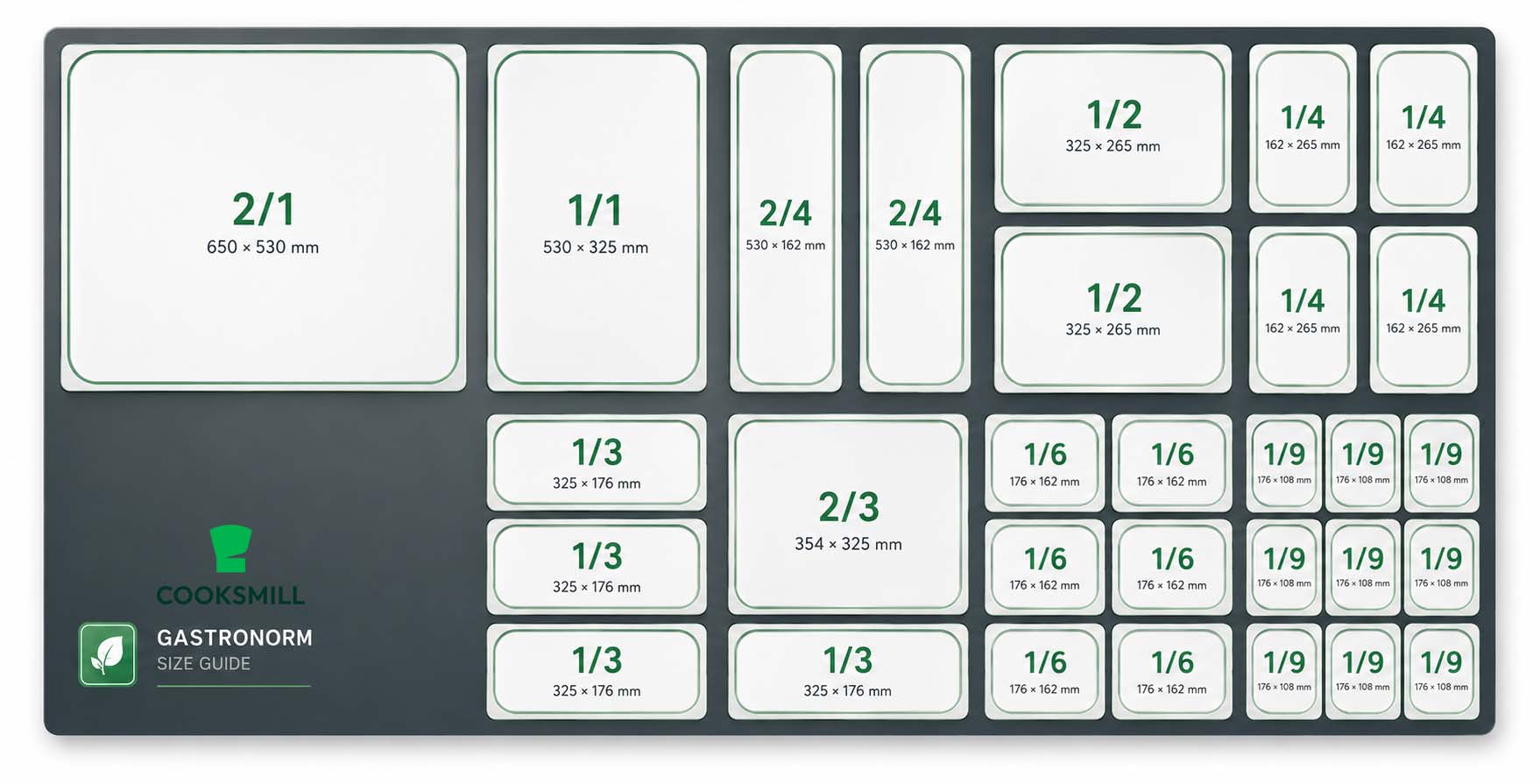
The standard Gastronorm size, also known as Full Gastronorm is 530 x 325mm. Eight more Gastronorm sizes are derived from this dimension. Any product in the EU region that states a Gastronorm size must abide by one of the following dimensions as stipulated by the European Standards Committee.
| GN Size | Dimensions | Description | Typical Use |
|---|---|---|---|
| GN 1/1 | 530 × 325mm | Full GN | Standard gastronorm size for cooking, storage, hot holding and service. |
| GN 2/1 | 650 × 530mm | Double GN | Large capacity container for bulk preparation and high-volume catering. |
| GN 2/4 | 530 × 162mm | Two-Quarters GN | Long narrow format ideal for buffet layouts, toppings and ingredient stations. |
| GN 2/3 | 354 × 325mm | Two-thirds GN | Flexible mid-size option for preparation, storage and service. |
| GN 1/2 | 325 × 265mm | Half GN | One of the most popular sizes for kitchens, prep areas and refrigeration. |
| GN 1/3 | 325 × 176mm | One-third GN | Perfect for sauces, ingredients, toppings and smaller food portions. |
| GN 1/4 | 265 × 162mm | Quarter GN | Suitable for condiments, garnishes and smaller quantities. |
| GN 1/6 | 176 × 162mm | Sixth GN | Compact container for mise en place, toppings and finishing ingredients. |
| GN 1/9 | 108 × 176mm | Ninth GN | Small GN size for sauces, garnishes and small ingredient portions. |
These are only the length and width measurements. The depth determines the capacity or the container — manufacturers design Gastronorm containers with varying depths for various applications. The depth and capacity are always stated in the product description; like this – GN1/1-100, 12.6-litre capacity.
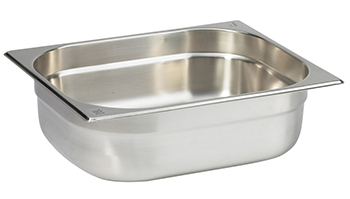
Stainless steel Gastronorm trays
Stainless steel gastronorm pans are the most versatile Gastronorm containers and are used for a variety of applications. These pans are robust, durable and excellent conductors of heat, making them ideal for oven cooking, and deep chilling.
Their polished shiny surface and heat retention properties of steel make the stainless steel pans great for buffet displays. In fact, most chafing dishes and bain-marie are designed for various sizes of stainless steel Gastronorm trays. And the beauty is, the food may come straight from the oven to a buffet without changing pans.
With a lid on, a steal Gastronorm pan can also be used to store food in a freezer of refrigerator.
Polycarbonate Gastronorm pans
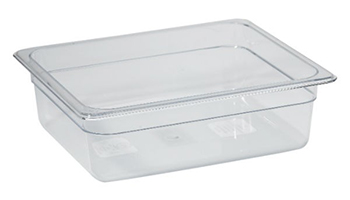
Gastronorm container can also be made from Polycarbonate or Polypropylene materials. Polycarbonate Gastronorm pans are mostly used in food preparation, chilling and buffet displays.
However, these pans are not good conductors of heat, which means they are not suitable for chaffing dishes or cooking. They are used to hold cold or chilled servings such as salads, puddings and fruits.
Unlike stainless steel pans, polycarbonate pans can be microwaved. They also remain cool to the touch even when holding hot or freezing food. They are also much better than steel pans at storing and freezing food. This is because they come with tightly fitting lids, and most of them are transparent – so, you don’t have to open the cover to see what’s inside.
Melamine Gastronorm Pans
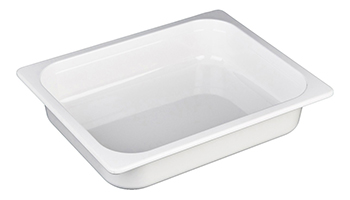
Melamine is a hard, lightweight material that closely resembles ceramic. It’s made from thermal setting plastic strengthened with melamine resin.
Gastronorm pans made from melamine should only be used to hold cold, chilled or lukewarm food. Melamine pans don’t fare well in high temperatures from any source, including microwave ovens and conventional ovens. The problem is, melamine starts to dry out when exposed to a lot of heat, which cause it to turn brown and form cracks.
These trays can, however, be used to chill and store food.
How to Choose the Correct Gastronorm Pan Size
Follow these steps to select the right gastronorm pan size for your kitchen requirements.
Step 1: Identify the equipment size
Check the dimensions of your oven, fridge, hot cupboard or preparation area to determine the GN size required.
Step 2: Choose the GN fraction
Select a full-size GN 1/1 pan or a smaller GN fraction depending on the quantity of food you need to store, cook or serve.
Step 3: Select the depth
Choose the pan depth based on food volume, with deeper pans providing greater capacity.
Step 4: Match the material
Select a suitable material such as stainless steel or polycarbonate depending on whether the pan is used for cooking, storage or display.
FAQ (Quick Takeaways)
Question: What does GN mean on a gastronorm pan?
Answer: GN stands for Gastronorm, an internationally recognised sizing system used for professional food containers and catering equipment.
Question: What is the standard gastronorm pan size?
Answer: The standard full-size gastronorm pan is GN 1/1, measuring approximately 530mm by 325mm.
Question: What are the most common gastronorm pan sizes?
Answer: Common gastronorm sizes include GN 1/1, GN 1/2, GN 1/3, GN 1/4 and GN 1/6, with different depths available.
Question: How deep are gastronorm pans?
Answer: Gastronorm pans are available in several depths, allowing kitchens to choose the right capacity for preparation, cooking and storage.
Other accessories
Besides lids, Gastronorm pans also come with a variety of corresponding accessories. Some of which include, Gastronorm grills, baskets and drain plates. These accessories are sized according to Gastronorm dimensions and are built from various materials such as stainless steel, plastic, and polycarbonates.
At Cooksmill, we have all the Gastronorm trays and accessories you need for a catering business. Browse through the online store or visit our shop in Manchester any day of the week to get your standard Gastronorm containers.